14 min read
Filing ITR-2 for My Mom: A First-Timer's Honest Log
Taxes, India, Personal Finance, ITR-2
TL;DR: If you are filing for a parent who has no job but earns bank interest and sells shares or mutual funds, the form is ITR-2, the new regime is probably the one you want, and almost all of the pain lives in one screen called Schedule 112A. Its first column wants the code
AE, not words, and for units bought after January 2018 a singleCONSOLIDATEDrow replaces the whole per-fund grind. Also worth knowing: even when the tax works out to zero, filing can still get you a refund.
My mom does not have a job. Her money comes from fixed deposits, a few dividends, and whatever she buys and sells in her trading account, plus a handful of mutual funds. I assumed filing her return would be a quiet one-evening job. It mostly was, except for one schedule that fought me for the better part of an hour. So this is the honest log: which form to pick, which regime, what to actually tick on screen, and the exact spot where the portal makes you earn it.
I am a developer, not a chartered accountant, and I leaned on an AI assistant for a good chunk of this, which I will come back to at the end. Nothing here is tax advice. It is just the path that worked for one return, written down so the next person in the same situation has an easier night than I did.
Who this is actually for
This is for you if the person you are filing for is a resident individual with no salary and no business, and their income looks like some mix of bank or FD interest, dividends, and capital gains from delivery-based shares, gold ETFs, or equity mutual funds. That is a very common shape for a retired parent or a homemaker who invests a bit.
This is not your post if they do intraday or F&O trading. That counts as business income and pushes you into ITR-3, which is a different animal. Buying something and later selling it is capital gains. Leverage and same-day churn is business. Know which one you are dealing with before you start, because it decides everything downstream.
Step 1: The form is ITR-2
The quick logic. Capital gains rule out the simplest form, ITR-1. But because she has no business income, you do not need the heavier ITR-3 either. ITR-2 sits exactly in the middle and is the right fit for interest plus dividends plus investment gains. If you find yourself reaching for ITR-3, stop and check whether you actually have business income, because most people in this category do not.
Step 2: Pick the regime, and decode the trick question
For this profile the new regime is almost always the better call. It has a large rebate and you probably have no deductions worth claiming, so the old regime just gives you a smaller exemption for no benefit. The portal defaults to new, and you want to keep it there.
Here is the part that made me read it three times. The portal asks:
Do you wish to exercise the option under 115BAC(6) of opting out of the new tax regime?
That is a double negative wearing a suit. You do not want to opt out, so you answer No. No means you stay in the new regime. Only say Yes if you have run the numbers and the old regime genuinely wins, which for a pure interest and investments profile it usually does not.
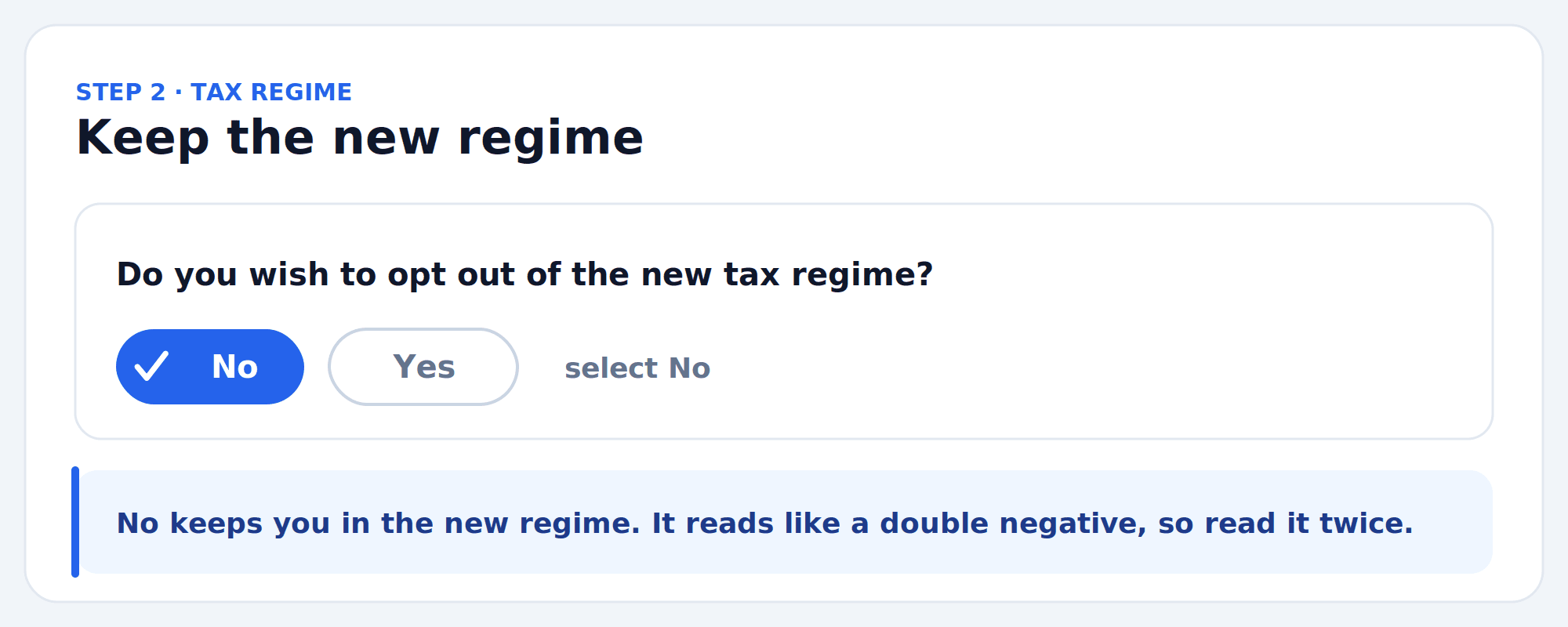
The wording is backwards from how your brain wants to read it. No keeps you in the new regime.
Step 3: Gather the papers, and the one everybody misses
You want four things open before you touch the form:
- The AIS and Form 26AS, both downloadable from the portal. These are what the tax department already knows about her interest, TDS, and sales.
- Your trading account's tax P&L for the year. Most brokers have a Reports or Tax P&L export that splits short term, long term, and intraday for you.
- Her bank interest figures.
- The mutual fund capital gains statement.
That fourth one is the trap. If any of the mutual funds were bought somewhere other than that trading account, directly with a fund house or through a distributor, those gains will not show up in the trading account's tax file. They sit in a separate mutual fund capital gains statement. If you only pull the trading account data you will quietly under-report a whole chunk of gains and never notice until a mismatch notice shows up months later. Ask for the consolidated capital gains statement, which a registrar like CAMS or KFintech has, and treat it as a first-class input.
Step 4: Select your schedules, and what to actually tick
The portal makes you pick which schedules apply before it lets you fill anything. For this profile, under the Income group you turn on Capital Gains, 112A, Income from Other Sources, and SI (income taxed at special rates). You leave Salary and House Property off. Keep the mandatory computation schedules that are pre-ticked, and do not go hunting for deduction schedules you will not use.
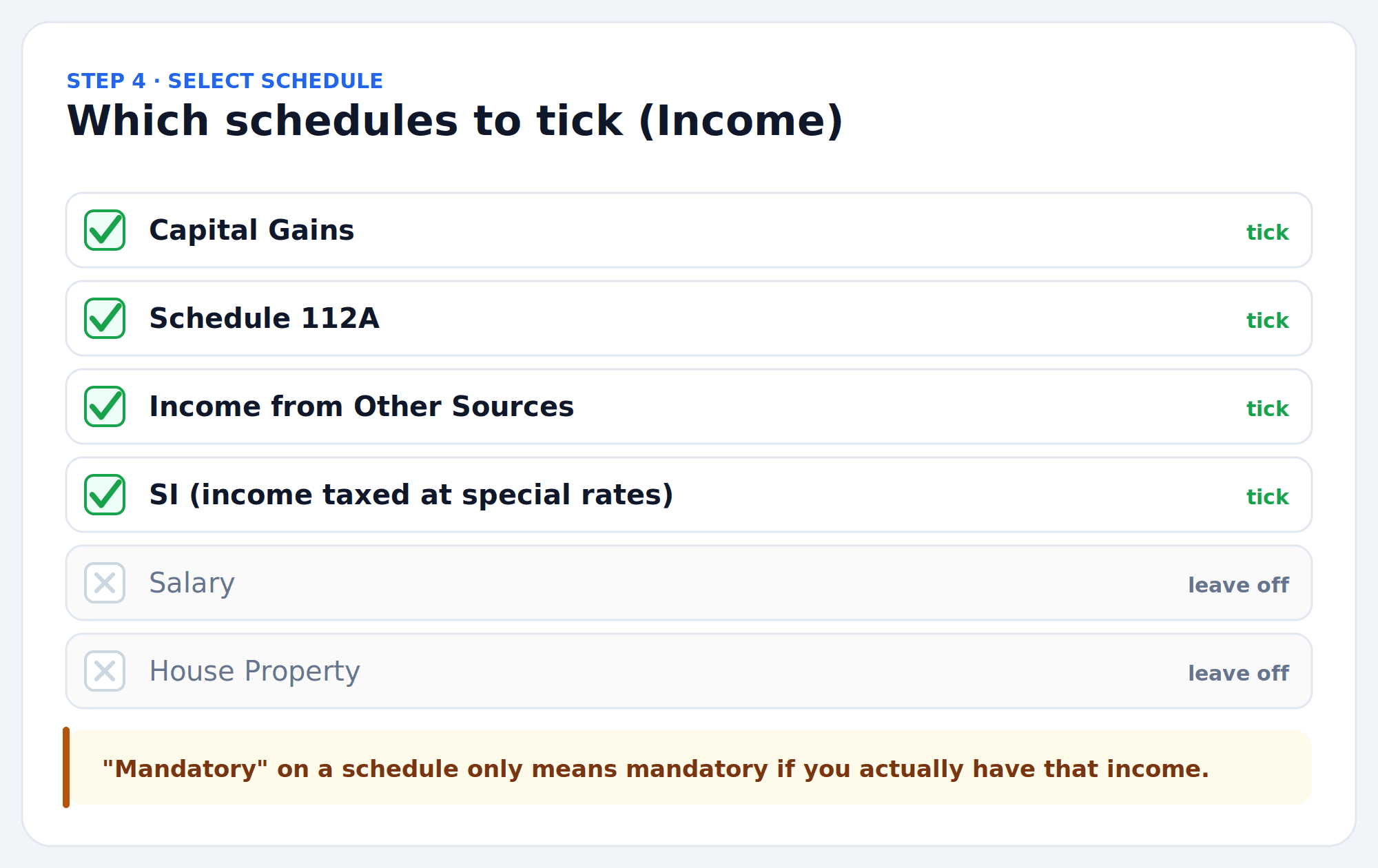
Capital Gains, 112A, Other Sources, and SI. That is the whole set for this kind of return.
One thing that threw me: Salary and Other Sources are both tagged "Mandatory," but that just means "mandatory if you have that income." You can absolutely proceed without Salary when there is no salary. The tag is describing the field, not ordering you to fill it.
Step 5: Capital gains, and the shares versus gold ETF split
Inside Schedule CG, the short-term section has separate boxes and it matters which one you use.
- Equity shares sold within a year go under the Section 111A box.
- Gold ETFs are not equity, so their short-term gain does not go in the 111A box. It belongs in the "assets other than the above" box, where it gets taxed at the normal slab rate instead of the special equity rate.
- Equity mutual funds held over a year are long term and go under Section 112A, which is its own screen. More on that next.
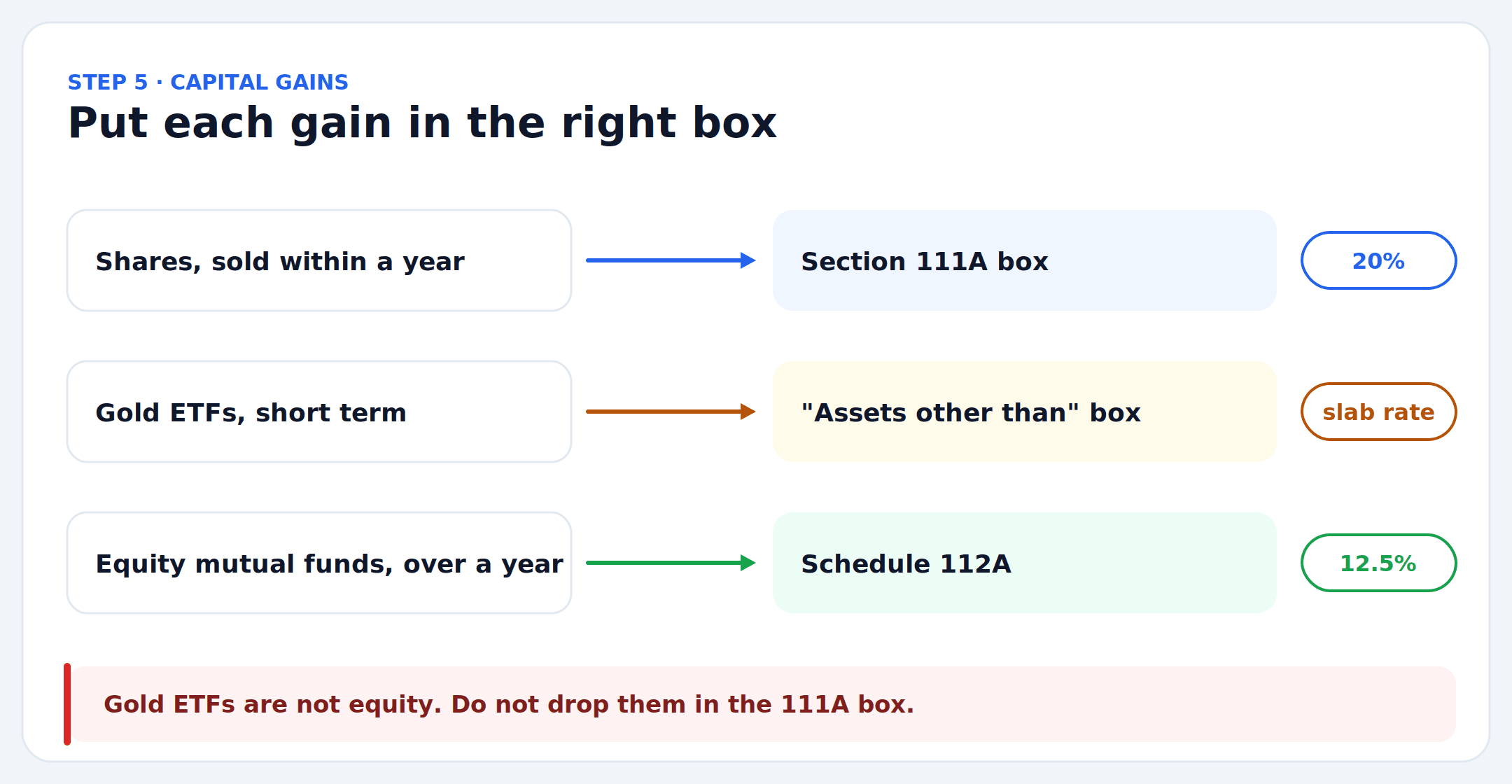
Shares in the 111A box, gold ETFs in the other assets box. Different rates, different rows.
Putting the gold ETF in the equity box is the easiest mistake to make here, because both are "things I sold in the trading account" in your head, but the tax treatment is different. Keep them in their own lanes.
There is also a quarter-wise breakup near the bottom of the schedule where you split each gain across the quarters it happened in. It only affects advance tax timing, so if your final tax is zero it changes nothing, but the form will not submit until it is filled. Just split by the actual sale dates and move on.
Step 6: Schedule 112A, the hour I am not getting back
This is where the evening went sideways.
Schedule 112A is where equity mutual fund long-term gains go, and it wants the data as a CSV upload, or a lot of manual rows. I filled the template, hit upload, and got this:
common.errors.csv_row_skip
Every row rejected, no explanation. I did what everyone does and started guessing. My first guess was the acquisition column. The header literally reads "Share/Unit acquired (On or before / after 31st Jan 2018)," so I typed the words "After 31st January, 2018" into it. Rejected again. I reworded it, cleaned up the number formatting, tried once more. Rejected.
The actual fix, buried in an old forum thread, is that the first column does
not take text at all. It wants a code. AE for units acquired after 31
January 2018, BE for before. That is it.
# what I typed (every row skipped)
"After 31st January, 2018", INF843K01013, ...

# what the parser actually wanted
AE, INF843K01013, ...
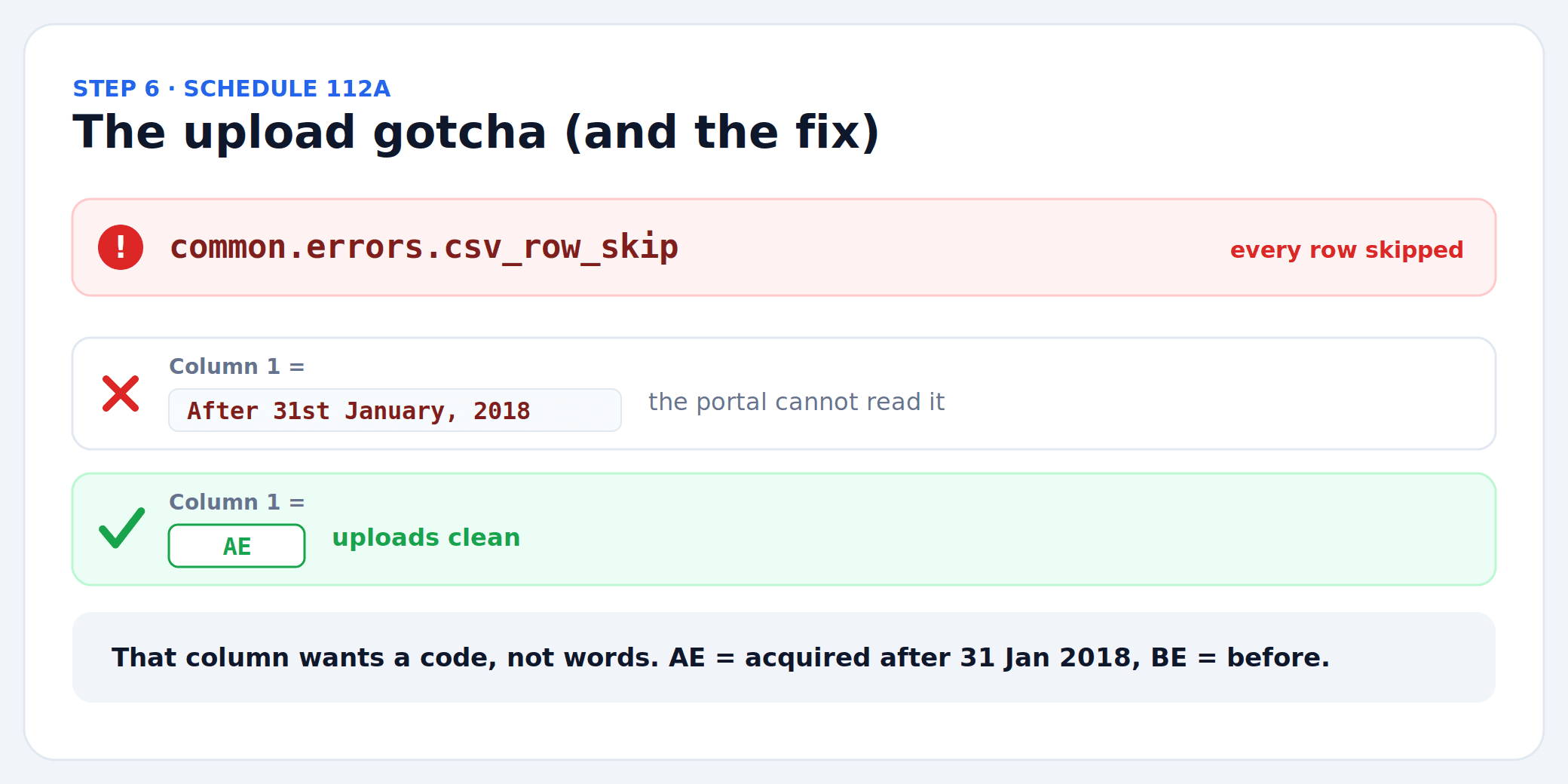
The error that tells you nothing, and the two letters that fix it.
So the lesson I paid an hour for: that column is a two-letter enum pretending to be a sentence.
But there is a much better ending. When I opened the manual entry form to
sanity-check the codes, the portal showed its own hint. For units acquired after
2018, the ISIN box faded in the placeholder INNOTREQIRD and the name box
showed CONSOLIDATED. Turns out that for post-2018 units, where there is no
grandfathering to worry about, you are allowed to skip the per-fund detail
entirely and enter one single consolidated row: acquisition set to after
2018, ISIN as INNOTREQIRD, name as CONSOLIDATED, and just the total sale
value and total cost across all the funds. One row, done.
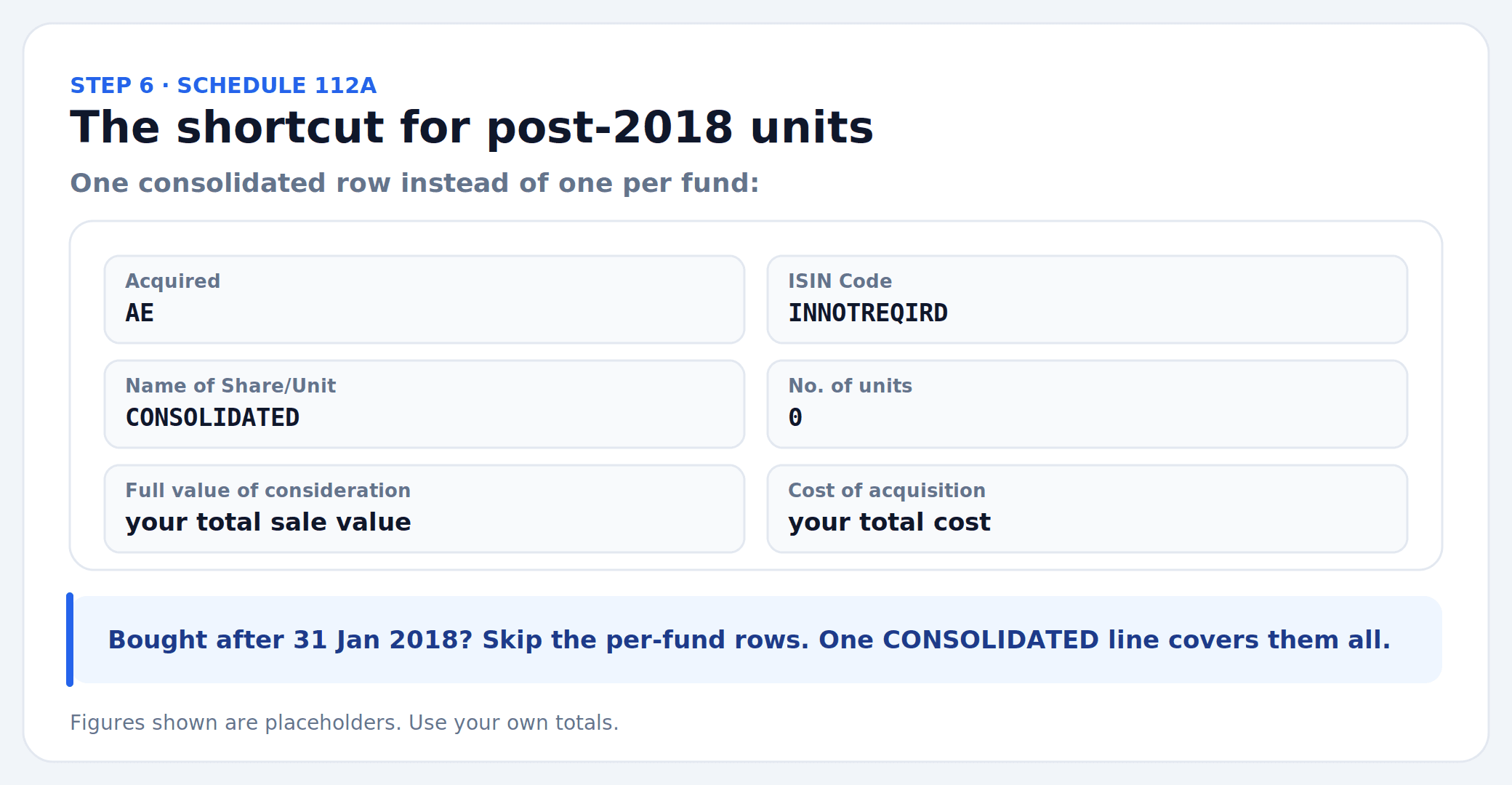
The shortcut nobody tells you about. Post-2018 units can go in as a single CONSOLIDATED row.
If I had known that at the start, the whole CSV saga would not have happened. So if all your mutual funds are post-2018, do not even bother with per-fund rows. Consolidate.
Step 7: Other sources, and the AIS knows more than you do
Interest and dividends go under Income from Other Sources, and most of it comes pre-filled from the AIS. Two small things surprised me.
First, the pre-filled interest total was slightly higher than the figure a tax-prep tool had shown me. I almost "corrected" it downward before I looked closely. The difference was interest the government had paid on a past tax refund, which is itself taxable and which the AIS had picked up but the other tool had missed. The takeaway: reconcile to the AIS number, do not fight it. The AIS is what the department sees, so matching it is what keeps you out of trouble.
Second, dividends have their own quarter-wise box, same as capital gains. Drop the amount into the quarter it was actually received in and leave the rest at zero.
Step 8: The plot twist, tax was zero and there was a refund
Here is the thing that made the whole exercise worth it, and the mental model that finally clicked for me.
TDS is not the tax. It is a deposit. During the year, when her FDs paid interest, the bank automatically held back a slice and sent it to the tax department against her PAN, as a prepayment. At year end you calculate the actual tax owed. If the real number is lower than what was already deposited, the difference comes back to you as a refund. And filing the return is the only way to trigger that refund. For a parent living mostly on interest, the entire point of the return can be reclaiming money that was withheld and never actually owed.
Why was the actual tax zero? Two public rules did the work. Under the new regime the basic exemption is fairly high, and for a resident, if total income sits under that limit, even the special-rate capital gains get absorbed into the exemption and taxed at zero. On top of that, long-term equity gains have their own yearly exemption before any tax applies. Stack those and a modest year of interest plus investment gains can land at no tax at all, which turns the whole filing into a refund claim.
So do not skip filing just because you are sure there is no tax to pay. No tax and no filing are different things. If any TDS was cut, filing is how you get it back.
Step 9: Do not forget to e-verify
This is the step people genuinely forget. Submitting is not filing. After you preview and validate, you have to e-verify, easiest with an Aadhaar OTP to the registered mobile. Until you do that, the return is sitting in limbo and does not count. Preview, validate, verify, done. You get an acknowledgement number and an email, and the refund lands in the pre-validated bank account a few weeks later.
A note on how I actually did this
I did not do this from memory or from any real knowledge of tax law. I leaned on an AI assistant for most of it, and it is worth being upfront about that, because it is the thing that changed how hard this felt.
What it was good at was the confusing middle. Decoding the double-negative regime question. Telling me which box a gold ETF gain goes in versus a share. Working out that the 112A column wanted a code and not words, and then that a single consolidated row would do the whole job. And at the end, reading back through the long preview PDF and checking my numbers against the source statements, so I was not just trusting that I had typed things into the right fields. A second set of eyes on a return that runs to dozens of pages, late at night, is not something I would have managed carefully on my own.
The broader point is that self-filing used to feel like something you needed a CA for, and for a return like this it just is not anymore. If you can describe your situation plainly and paste in what each screen shows, you can get walked through it one field at a time. It turned a chore I had been putting off into an evening of following clear steps.
Two caveats, because I want to be straight about it. It is still your return, so read what you are about to submit, and do not paste in anything you would not want a tool to have. And AI does get things wrong, so for anything unusual or high value, check it against the official portal help or a real CA before you file. For a plain interest and investments return like my mom's, doing it myself with a bit of help was faster, cheaper, and less stressful than I expected.
Takeaways
- ITR-2 is the form for capital gains without business income. If you are reaching for ITR-3, double check you actually have business income.
- New regime plus the resident basic exemption can quietly zero out a modest year of capital gains. Say No to "opting out."
- Mutual funds bought outside your trading account are not in its tax file. Pull the separate capital gains statement, from a registrar like CAMS or KFintech, or you will under-report.
- Schedule 112A's first column is an AE / BE code, not text. And for post-2018 units, a single CONSOLIDATED row saves you the whole grind.
- Reconcile to the AIS, not to your own spreadsheet. It knows about things like refund interest that you will miss.
- Zero tax still means file, to get the TDS refund, and it is not filed until you e-verify.
The happy path, if I did it again tomorrow:
Form:       ITR-2
Regime:     New  (answer "No" to opting out)
Schedules:  Capital Gains, 112A, Other Sources, SI, plus the mandatory ones
Shares STCG:    111A box
Gold ETF STCG:  "assets other than" box (slab rate)
Equity MF LTCG: Schedule 112A
112A column 1:  AE (acquired after 31 Jan 2018)
112A shortcut:  one CONSOLIDATED row, ISIN = INNOTREQIRD
Finish:     Preview -> Validate -> e-Verify (Aadhaar OTP)
None of this is hard once you know it. It is just that the portal assumes you already know the codes, the boxes, and the shortcuts, and it will not tell you when you get them wrong. Now you know them. Go get your parent their refund.
Usual disclaimer: I am not a tax professional, this is an account of one return, and the rules change every year. Check your own situation, and if it is bigger or weirder than a bit of interest and some investments, talk to a CA before you submit.